 Français
 English
 Deutsch
 español
 Italiano
 日本語
 Eλληνικά
 русский
 português


If you’re planning to drain a field, you will soon hear three machines mentioned in the same breath:
- the trencher,
- the drainage plough,
- the mole plough.
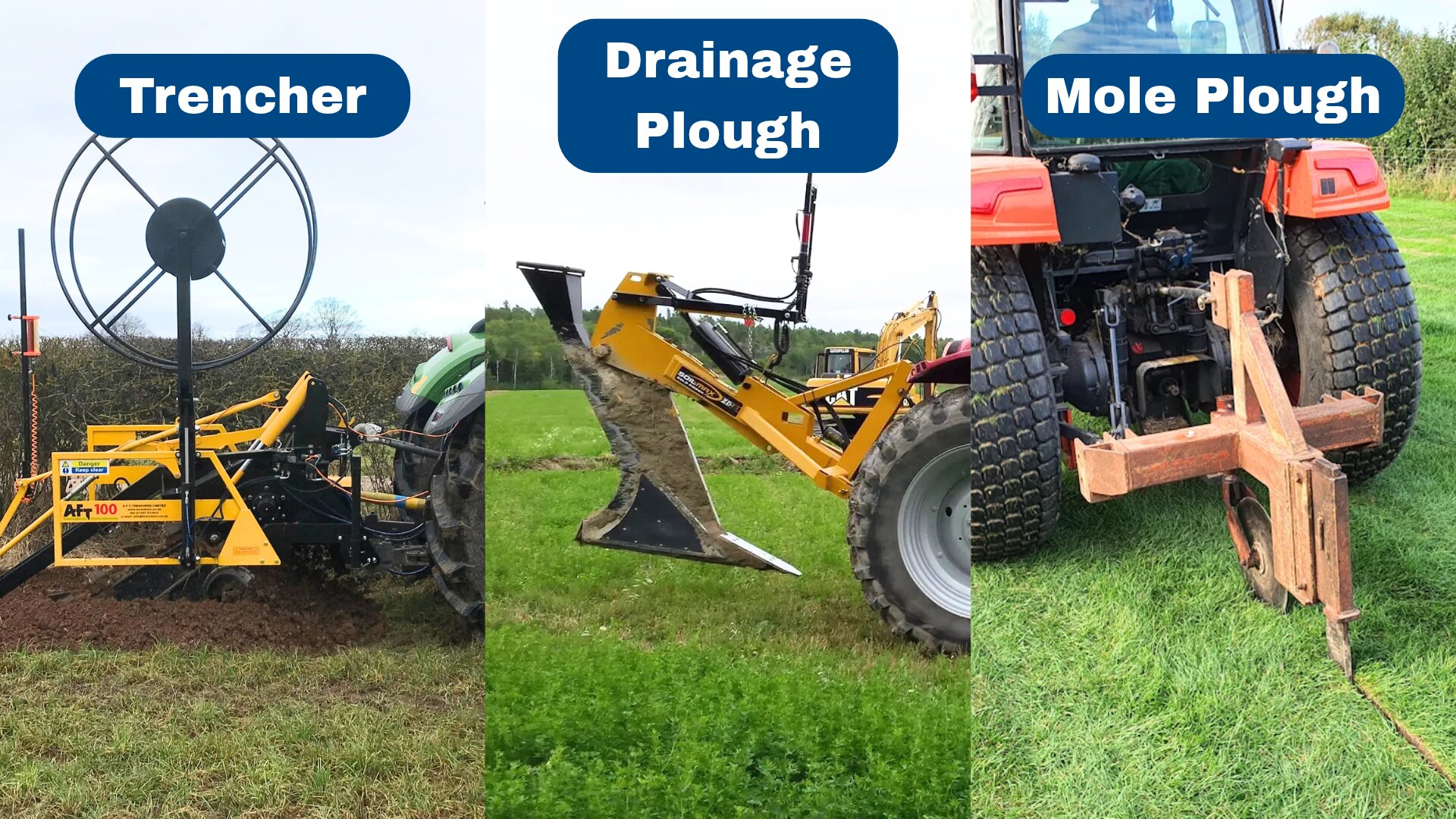
They are all used for drainage, so it is easy to assume they do the same job.
They do not. Two of them lay drainage pipe. One of them does not.
The choice between them affects how your drains perform for decades, which tractor you need, and whether you can mole drain the field in the future.
This guide explains:
- What each machine does,
- Where each one wins,
- How to decide what suits your land.
Three machines, two different jobs
First, these machines don’t all do the same job.
A field drainage scheme usually has two layers.
Primary drainage is the permanent piped system: laterals running across the field and feeding into a main.
Secondary drainage sits above it and helps water reach the pipes faster, usually through mole channels in heavy clay.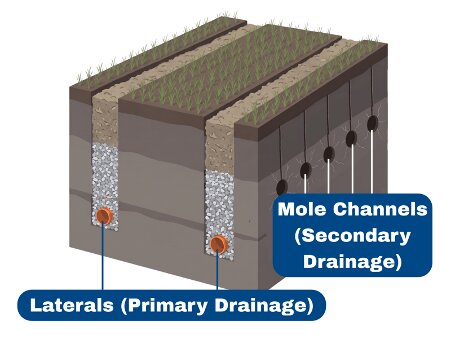
Tractor-mounted trencher
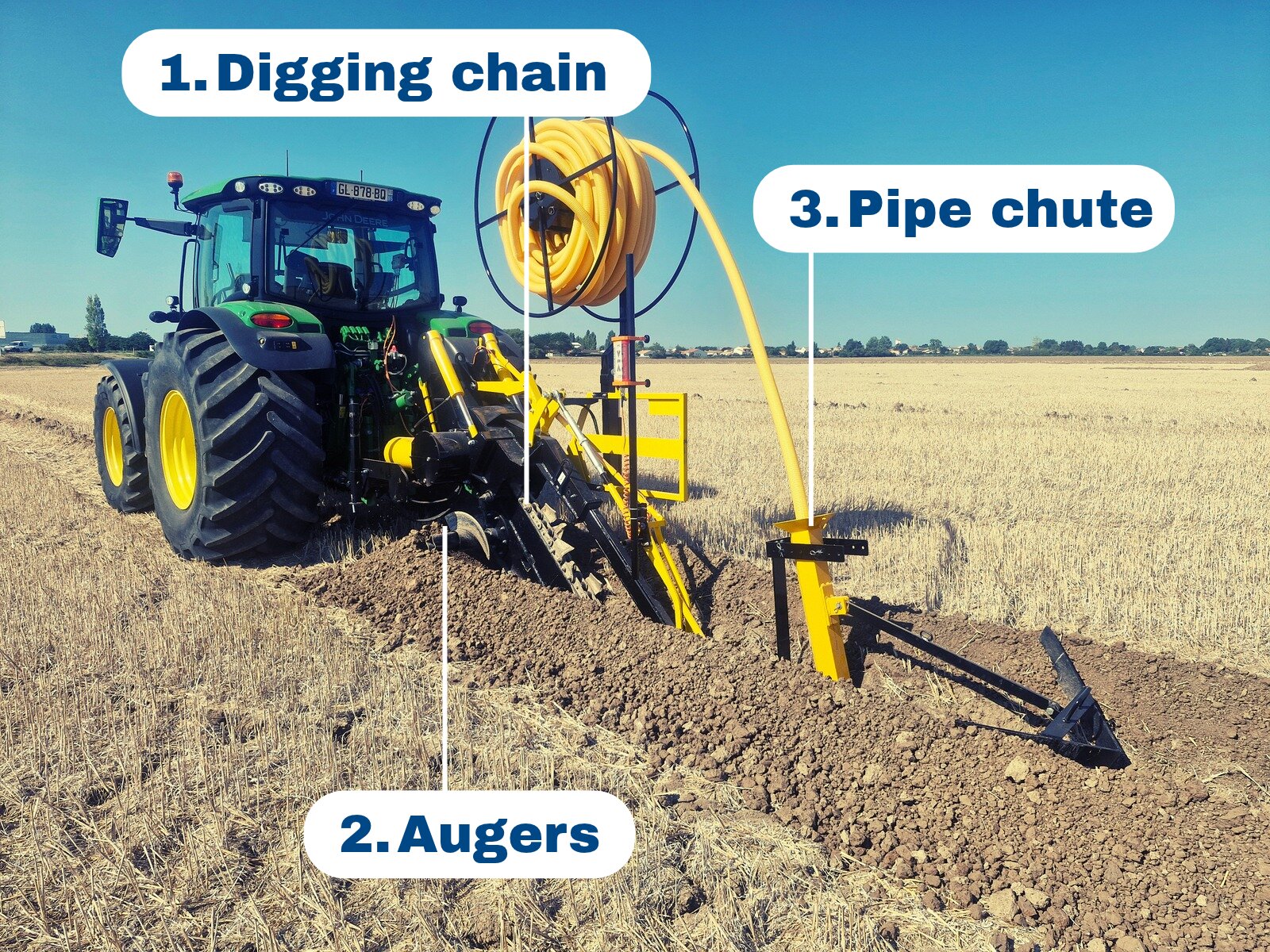
A trencher:
- Cuts an open trench with a digging chain.
- Augers on either side of the chain place the soil beside the trench, ready for backfilling.
- Lays the drainage pipe in the trench.
- Optional: Places gravel over the pipe.
Drainage plough (trenchless)
A drainage plough pulls a blade through the ground and feeds pipe in behind it, with no open trench.
Contractor machines often have a gravel box that drops stone over the pipe as it goes.
One often requires a trace horse (one tractor pulling another) to generate enough power to pull a drainage plough.
If you use this form of drainage, you will have to consider the diesel for both tractors and two drivers.
Mole plough
A mole plough drags a bullet, followed by a slightly larger expander through the subsoil at a depth of around 500 to 600 mm.
That leaves a channel that carries water into the piped drains below.
There is no pipe. It is secondary drainage only, and the channels need renewing every five to eight years.
Take core samples to check whether the soil is moist enough to use a mole plough. If too sandy, the mole channel will simply collapse.
So the real buying decision is between a trencher and a drainage plough.
The mole plough is complementary for secondary drainage, once your primary drainage is installed.
Trencher vs drainage plough: what matters
Speed
On a big, open field with easy ground, a drainage plough lays pipe faster than a trencher.
A large trenchless machine can cover many metres in a day, and if speed matters, the plough has the edge.
For a farmer doing their own drainage with an AFT100, customers tell us they can lay around 1,500 metres in a day. Lawson’s farm is a good example.
That is a pace you can plan around between harvest and drilling, on your own timetable, and when weather conditions are ideal, without waiting for a contractor.
However, speed is not the only thing that decides whether a drainage scheme works.
Seeing what you are doing
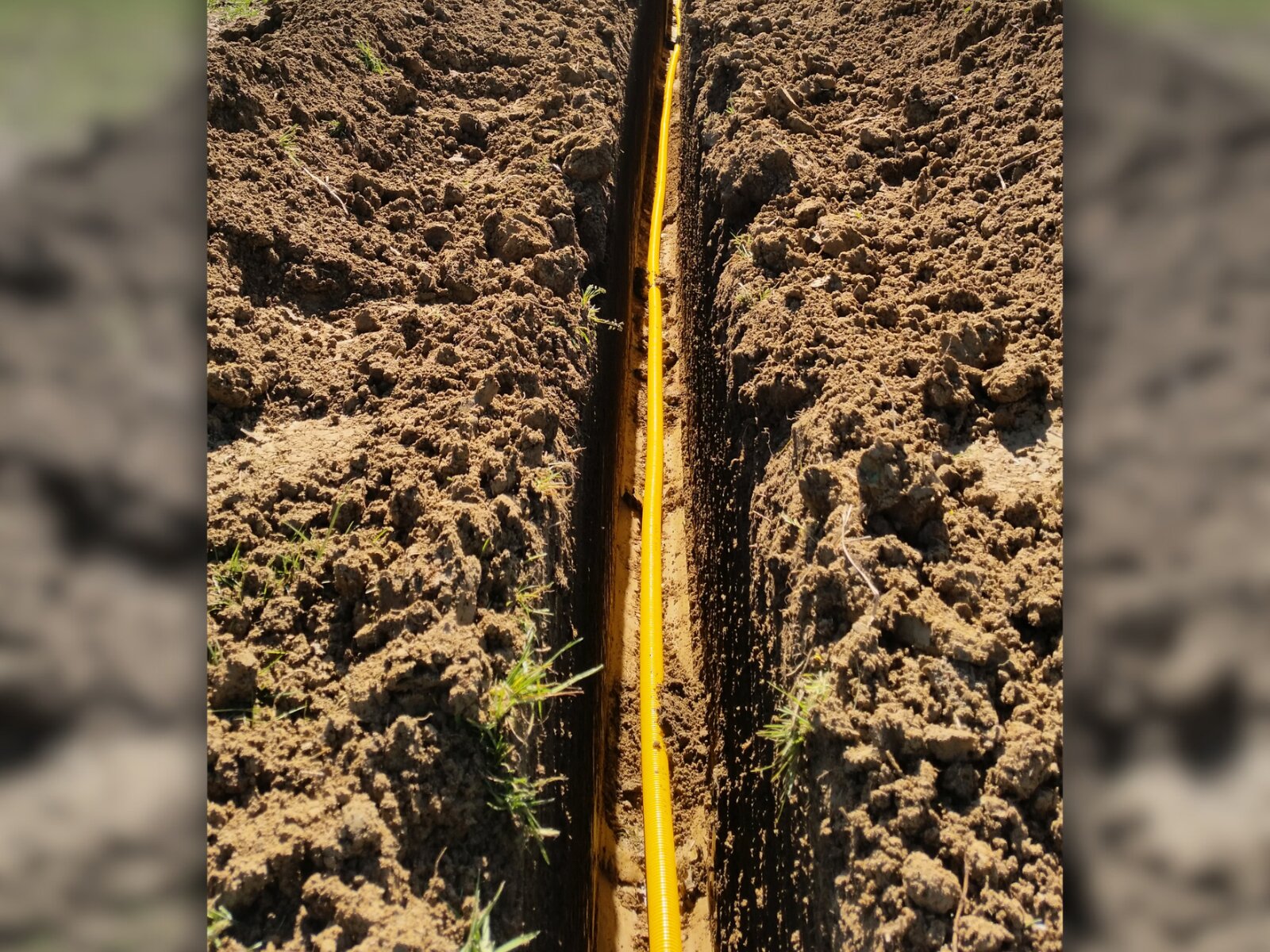
With a trencher, the trench is open behind you.
You can see if you have cut through an old drain, so you can repair it and keep it working instead of letting it block up.
You can also see the pipe sitting properly at the bottom of the trench before you backfill.
A drainage plough works blind.
Once the pipe is in the ground, you cannot see it. You can only check it indirectly, by pushing a rod down the pipe or measuring its depth along the run. On land with an old drainage system already in it, that is a real difference.
Gravel backfill and soil smearing
On heavy land, gravel over the pipe does two jobs:
- It lets water from the natural cracks and fissures in the soil drain down into the stone and into the pipe.
- It gives any future mole channels something permeable to connect to. The mole bullet is drawn through that gravel, which is how moled water reaches the pipe.
On clay, permeable backfill also helps the drains themselves last longer.
With a trencher, putting stone over the pipe is part of the normal process. On the AFT100, a combined pipe and gravel chute lets you lay pipe and gravel together.
A plough working in wet conditions can smear the sides of the slot it cuts. That smearing can slow water’s natural movement toward the pipe. It is one of the main reasons drainage contractors still choose a trencher on heavy ground.
A drainage contractor we work with put it this way: with a chain trencher and stone backfill, you can often space the laterals further apart and mole at a shallower depth, which needs a much smaller mole plough.
Getting the gradient right
Drains only work if they fall the right way.
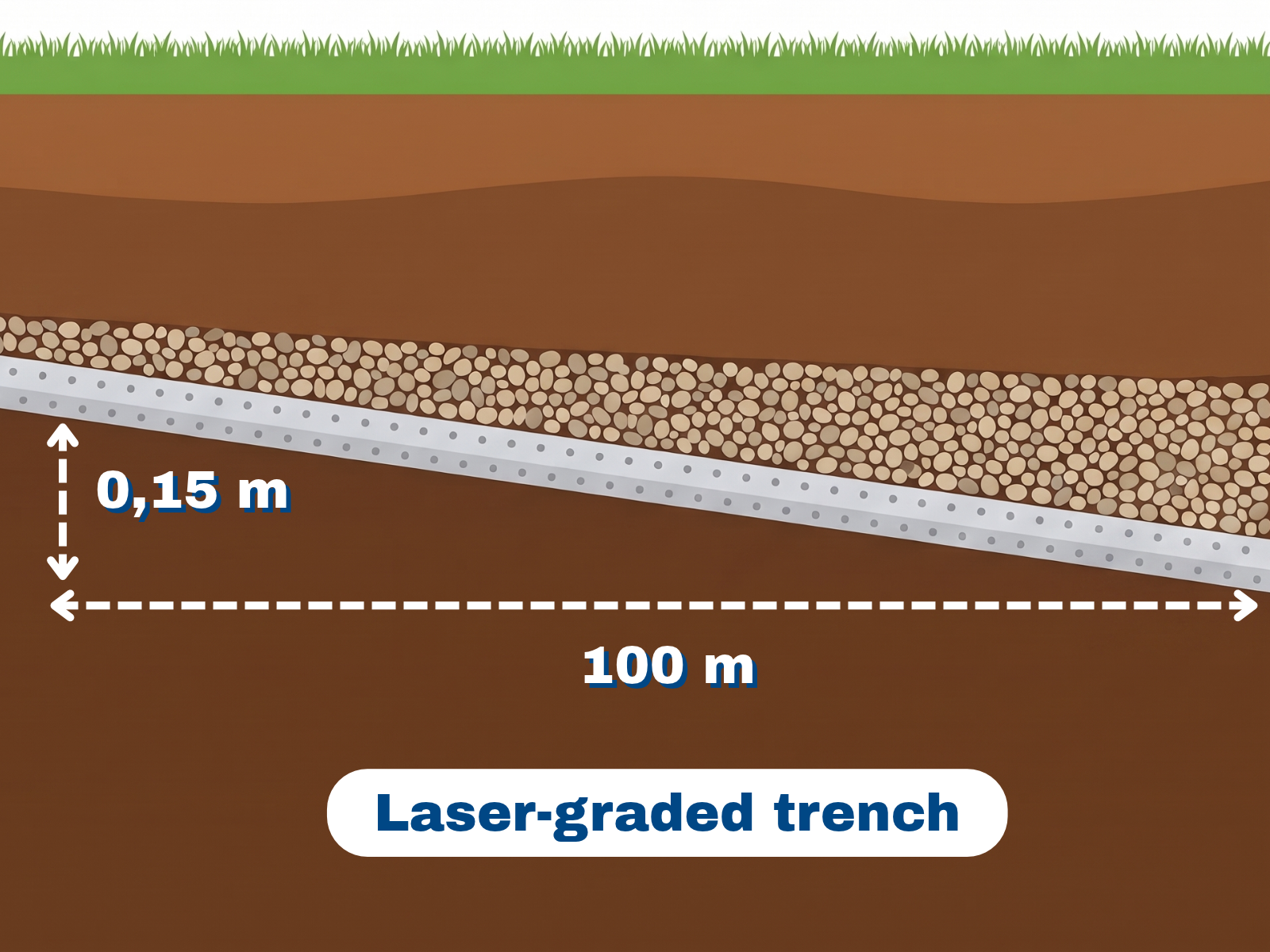
- Gradient with a trencher: A trencher with a laser system sets the trench depth automatically, so you can hold whatever fall your drainage design calls for. At Mead Farm in Cambridgeshire, they set a fall of 0.15 to 0.25 m over every 100 m, and the laser system on their AFT100 adjusted the depth as required.
- Gradient with a drainage plough: Drainage ploughs also use laser or RTK guidance. The challenge is the tractor. A trenchless drainer meets a lot of resistance, and the rear tyres can squat and heave under the load. That can make holding an accurate grade harder than it sounds.
Tractor size and wet ground
- What tractor for a drainage plough? A plough needs weight and traction above all else. Contractors we work with suggest a 350 hp or more tractor to pull one properly. And plough grip drops quickly once the topsoil gets wet, which is a problem in a wet autumn.
- What tractor for an attachment trencher? A tractor-mounted trencher is lighter, and its weight sits close to the three-point linkage, so it is easier to lift and carry. It runs on a mid-size tractor (from 100 hp) with a creeper gearbox or VARIO transmission. Because it does not rely on pulling power, it handles soft ground better.
Soil and stones
With the right combination of teeth and blades, an AFT trencher can work in anything from sand to rocky soils.
The same can be said for a drainage plough, which is pulled by one or two tractors and can cope with hard ground resistance.
A plough can struggle in heavy soil below a certain depth, where the blade can smear and compact the ground around the pipe, reducing how well water gets through.
Depth
Our AFT100 digs to 1.8 m, even to 2.0 m if required.
Drainage ploughs typically work at around 1.2 to 1.6 m depending on the model.
The deeper you go, and the heavier the soil, the more resistance a plough meets, and the harder it is to pull.
A trencher keeps cutting at depth without needing a bigger tractor.
Surface finish
A trencher leaves a clean trench and neatly places the spoil to the sides, ready to be used as backfill.
If you are backfilling with stone, you will need a gravel cart alongside, but pipe and gravel can go in on one pass.
A drainage plough tends to leave a ridge that is too big to cultivate through, so you will often need a loader or digger to knock the tops off.
Moreover, a drainage plough can generate heave in dry conditions.
Where the mole plough fits in
A mole plough is not a competitor to either machine. It works alongside a piped system.
Moling suits heavy clay soils: at least 30% clay, no more than 30% sand, and no stones at mole depth.
The AHDB guidance on mole drains is a good starting point.
It is not suitable for land with rising groundwater. It is done when the soil at depth allows for a mole channel to be created, usually between May and September or October.
The catch is that a mole plough has no depth control.
It follows the lie of the land rather than a set gradient.
And it only works if the mole channels cut through permeable backfill over your pipes.
That is where your primary drainage choice comes back into play.
If your laterals went in without gravel, the mole channels may have nothing to drain into.
Laying pipe with stone backfill, which is part of normal trencher work, keeps moling open as an option for the life of the scheme.
Side-by-side comparison
| Tractor-mounted trencher | Drainage plough (trenchless) | Mole plough | |
|---|---|---|---|
| What it does | Cuts an open trench, lays pipe, optional gravel | Pulls pipe into the ground with no open trench | Forms an unlined channel, no pipe |
| Type of drainage | Primary (laterals and mains) | Primary (laterals and, on larger models, mains) | Secondary only |
| Working depth | AFT100: up to 1.8 m | Around 1.2 to 1.6 m | Around 500 to 600 mm |
| Can you see inside the trench (for old pipes or for suitability for a mole plough)? | Yes | No | No |
| Gravel over pipe | Yes, laid with the pipe or after | Yes, with a gravel box | No |
| Gradient control | Laser | Laser or RTK, affected by tractor squat | None, follows the land |
| Soil and stones | Sand to rocky ground, with the right teeth and blades | Copes with loose stones and small stumps; can smear heavy soil at depth | Heavy clay, stone-free at mole depth |
| Tractor | Mid-size, creeper or hydrostatic | 350 hp plus | From around 140 hp |
| Wet ground | Copes well | Loses grip quickly | Needs a dry surface |
| Surface finish | Neat trench, spoil in bands | Ridge that needs knocking down | Narrow slot |
| Lifespan | Permanent pipe | Permanent pipe | Renew about every 5 to 8 years depending on soil conditions |
| Other uses | Cable, water pipe, civil work | Drainage only | Drainage only |
| Diesel consumption | Medium | Very high | High |
Which one suits your farm?
Choose a tractor-mounted trencher if:
- You are laying a permanent piped system.
- You want gravel over the pipe, so you can mole on top later.
- You want to see the trench before you backfill.
- You run a mid-size tractor with a creeper gearbox or VARIO transmission.
- You want the same machine to also lay cables or water pipes, so it earns money between drainage jobs.
A trencher avoids heave, lets the operator see inside the trench, and lets you use the machine when conditions are optimal.
Choose a drainage plough when:
- Speed matters in large open fields with a need to lay a lot of pipe at 1 to 1.2 m.
- You use a 350 hp plus tractor or a tracked machine.
Choose a mole plough if you farm heavy clay with little sand and no stones at 50 to 60 cm, sitting over a working piped system with gravel backfill.
Pulled every five years or so in dry summer conditions, it’s the cheapest way to get water into the drains you’ve already paid for.
For many farms, the answer is a combination: a trencher for the piped system, with stone backfill, then a mole plough on top.
Talk to us about your land
Every field is different, and the right machine depends on your soil, your tractor, and how much drainage you need.
You can see the full agricultural trencher range on our agricultural drainage page.
If you would like advice on your own project, get in touch with our team. We will talk you through the options.
