English
 Français
 Deutsch
 español
 Italiano
 日本語
日本語 Eλληνικά
 русский

Agricultural land drainage has been going on for centuries, and over that time it has played a major role in shaping the landscapes we see today. From productive arable land and grazing pasture to managed wetlands and conservation areas, drainage has influenced how land is used, how crops are grown, and how farmers manage water across their land.
At its core, land drainage is about controlling excess water. Poorly drained land can quickly become waterlogged, leading to reduced crop yields, damaged soil structure, restricted access for machinery, and challenges for livestock. Well-designed agricultural drainage systems remove surplus water efficiently, helping soil to function as it should and allowing land to be worked when it needs to be.
A Brief History
Agricultural field drainage became particularly widespread during the 18th and 19th centuries, although forms of drainage existed long before that. Between 1840 and 1890 alone, it is estimated that around 12 million acres of land in the UK were drained. This enormous undertaking permanently altered the rural landscape and laid the foundations for modern farming.
Some of the earliest drainage schemes were vast in scale. The drainage of the Fens is one of the most well-known examples, transforming large areas of wetland into highly productive farmland. Before major drainage works, this land was frequently flooded and unsuitable for conventional agriculture. After drainage, it became some of the most fertile land in the country.
Alongside these large projects were countless smaller, local drainage schemes. Individual farmers installed ditches and later sub-surface drainage systems to improve waterlogged fields. These more localised interventions allowed land to be used for grazing or crop production where it previously could not, and collectively they reshaped much of the countryside we recognise today.
From hand digging to modern trenching
Digging agricultural drainage ditches was once a mammoth task. Early systems were excavated by hand using basic tools, often in challenging conditions. Maintaining these ditches required constant effort to prevent collapse or blockage.
Today, agricultural drainage is far more efficient thanks to modern machinery. Purpose-built trenching machines allow farmers and contractors to install drainage systems quickly, accurately, and with far less labour. This shift has made drainage more accessible, cost-effective, and precise, particularly for farmers who want control over when and how drainage work is carried out.
This is where specialist equipment suppliers such as AFT Trenchers play a key role. By supplying practical, farm-friendly trenching machines, they enable landowners to manage drainage in-house rather than relying solely on contractors or large self-propelled machinery.
Efficient Drainage with the AFT100 Trencher
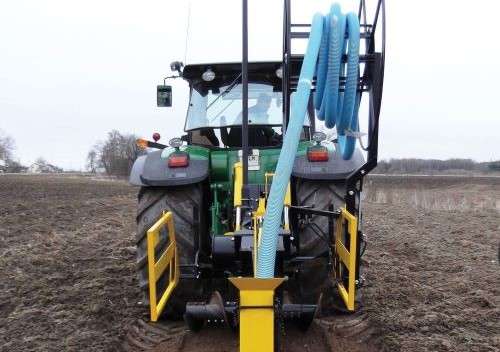 For larger agricultural drainage projects, the AFT100 Agricultural Drainage Trenching Machine is designed specifically with farmers in mind. It provides a highly cost-effective way to install drainage systems without the expense of backhoes, excavators, or large specialist contractors.
The AFT100 allows you to trench when conditions are right for your land, rather than waiting for contractor availability. This flexibility can make a real difference during busy periods or when weather windows are tight.
One of the standout advantages of the AFT100 is its ability to lay pipe and gravel at the same time. Using the hydraulic pipe reel carrier alongside the combined pipe chute and gravel hopper, drainage installation becomes a streamlined, single-pass operation. This not only saves time but also ensures consistency across the entire drainage run.
Accurate gradients are essential for effective land drainage, and the AFT100 supports this with semi-automated or fully automated laser systems. These systems allow the trench slope to be set precisely, ensuring water flows correctly and reducing the risk of standing water or blockages in the future.
The result is a clean, consistent trench that helps prevent land from becoming saturated and waterlogged. This improves crop performance, protects soil structure, and reduces accessibility issues for machinery.
Compact Land Drainage Solutions with the AFT45
Not every drainage project requires a large machine. For smaller farms, restricted spaces, or specialised growing environments, the AFT45 trencher offers a compact and versatile solution.
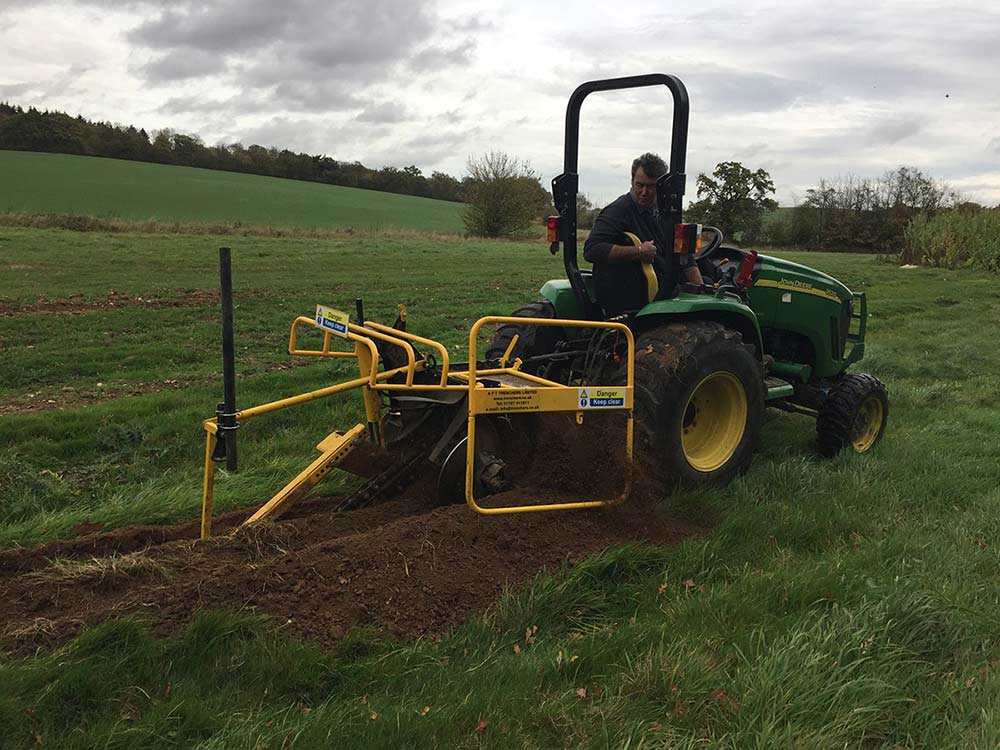
The AFT45 can be operated with a 30+ HP tractor, making it accessible for many farms without the need for additional machinery. Its compact design makes it particularly well suited to orchards, vineyards, greenhouses, and other areas where space is limited.
Despite its size, the AFT45 delivers a clean-cut trench and is highly cost-effective when compared to self-propelled trenchers. It is easy to transport on a trailer and allows farmers to carry out drainage work exactly when needed, regardless of contractor schedules or weather delays.
Spoil is placed neatly on one side of the trench, allowing for easy backfilling using a simple tractor-mounted blade. Optional conveyor systems and laser grading equipment further enhance accuracy and efficiency, making the AFT45 a practical choice for precise drainage work.
The Benefits of Modern Land Drainage
Effective agricultural land drainage offers a wide range of benefits, including:
- Improved crop yields and consistency
- Better soil aeration and structure
- Reduced surface water and compaction
- Improved access for machinery
- Healthier grazing conditions for livestock
- Reduced risk of erosion and runoff
By investing in the right drainage equipment, farmers can protect their land, improve productivity, and respond more effectively to changing weather patterns.
Balancing drainage and the environment
Land drainage has also had a significant impact on habitats and wildlife. While historic drainage reduced some wetland areas, many modern drainage systems are designed with environmental considerations in mind. Managed ditches and drains can support biodiversity, providing habitats for insects, birds, and small mammals.
Well-planned drainage helps control water flow, reduces sediment entering watercourses, and supports more sustainable land management overall.
A long-term investment in your land
Agricultural land drainage remains a vital part of modern farming. With increasingly unpredictable weather, having the ability to manage excess water efficiently is more important than ever.
Modern trenching machines from AFT Trenchers give farmers the tools to install and maintain drainage systems effectively, on their own schedule and at a fraction of the cost of traditional methods. From large-scale field drainage to compact, precision trenching in restricted spaces, the right equipment can make a lasting difference to the productivity, accessibility, and resilience of agricultural land.